
Starting your BEd UF Englisch
The BEd and the MEd UF Englisch programmes are the foundation to work as a professional teacher of English in the Austrian secondary school context, which covers years 5 to 13 in general and professional schools. Mirroring the pillars of teacher education, we address
- Content knowledge, i.e. the fields of knowledge encompassing the subject English. You will learn about linguistics in relation to the English language, including how languages are learnt, how culture(s) and literature(s) produced in English can be understood, and develop your own language proficiency and knowledge about the language. You will develop first a basic (in the BEd) and then an advanced understanding (in the MEd) of the processes of research in the humanities and social sciences.
- Pedagogic content knowledge, i.e. learning how to make content knowledge relevant to learners. This includes knowledge on teaching and learning and, importantly, an understanding of how general knowledge of the subject English can be made accessible and relevant to learners in different contexts and with different individual features. You will understand the foundations of planning and conducting English language teaching, providing feedback and evaluating learners’ performance. You will gain an initial understanding of evidence-based teaching.
- Practical knowledge, i.e., applications of the above two types of knowledge to classroom contexts. This includes gaining practical experience in a school-based internship and reflecting on this experience.
You will also gain foundations of research literacy, i.e. an understanding of how to engage with research to ensure that your professional practice is evidence-based and also to enable you to undertake small-scale research studies on your own.
The four elements of the programme, cultural and literary studies, English language teaching methodology, language competence and linguistics are all taught in a mixture of lectures and more interactive classes. You will need to complete a BEd thesis in cultural/literary studies OR linguistics, and an MEd thesis in one of your two subjects, including a viva voce exam of 60 minutes, which will earn you your Masters degree.


Orientation session for your degree programme
At the beginning of the semester we offer an orientation session Orientierungsveranstaltung for BEd beginners with some more information on your first semester and the possibility to ask questions. Please register for your session via u:find/u:space, “Orientierungsveranstaltung”, by the previous evening.
You won’t be able to register if you have not completed your admission to the university (“Zulassung”). On the day of the “Orientierungsveranstaltung”, please log in to Moodle, find the course in your Dashboard and enter the stream.

Your study programme at a glance


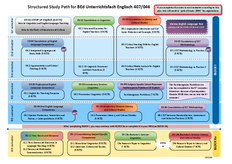
Find out how to switch to the new BEd/MEd programme.
What does your first semester look like?
-
VELT
Vienna English Language Test: the department's standardised language test and prerequisite for the modules EN 04, EN 06, and EN 07.
-
Start introductory and orientation period (STEOP)
Your first lectures and exams in the BEd UF Englisch.
-
Latin supplementary exam
Students who have not completed at least ten hours of Latin per week at a secondary school prior to their studies need to take the Latin supplementary exam.
Accessible Studies (Barrierefrei studieren)
Students with impairments, disabilities, or illnesses are advised to consult with our colleagues at Team Barrierefrei. Depending on your condition, you can get advice on the provisions and alternative modes of assessment, tailored to your needs.
How to prepare your timetable
At the University of Vienna you do not get a pre-defined timetable, but follow a recommended study path – you plan your semester yourself. The most important tools for planning your semester are the curriculum of your degree programme, the student portal u:space and the course directory u:find.
In your record of examinations in u:space you can also view all the grades you receive during your degree programme. This overview will help you plan the next semesters.
Need help planning your courses?
What types of courses are there?
-
Course with non-continuous assessment
Courses with non-continuous assessment (npi LV) are, for example, lectures (Vorlesung, VO). The following applies to lectures:
- Attendance is not compulsory.
- The number of participants is not limited.
- You do not obtain ECTS credits simply by attending a lecture. To complete a lecture and obtain ECTS credits, you must take an exam at the end.
- Registration for the exam is mandatory.
In general, we recommend registering for lectures, as you will then automatically be enrolled on the corresponding Moodle course. This gives you access to the learning materials.
PLEASE NOTE: You must also register for the exam even if you have already registered for the course with non-continuous assessment.
-
Course with continuous assessment
Courses with continuous assessment (pi LV) are, for example, seminars (Seminar, SE) and exercises (Übung, UE). Please note the following:
- You must register for courses within the registration period.
- Assessment is based on active participation through written and/or oral achievements during the semester.
- Attendance may be compulsory.
The number of participants is usually limited. After the registration period, you can check in u:space whether you have been allocated a place in the course.
PLEASE NOTE: If you miss the first course unit without providing a reason, you will be deregistered and lose your place.
-
Module examinations
A module examination or subject examination is an examination on the content of an entire module (i.e. an examination on the content of several courses).
- Assessment is based solely on the examination result.
- Attendance or participation in the courses is not taken into account in the assessment.
- Module examinations – with the exception of STEOP examinations – take place three times during each semester.
-
Do you still have questions about certain university terms?
We have compiled an overview of all important terms and abbreviations in our ABC of terminology.
What is the introductory and orientation period (STEOP)?
All bachelor’s, teacher education and diploma programmes include an introductory and orientation period (STEOP) in the first semester.
The STEOP gives you an insight into the programme and allows you to assess
- whether the course content aligns with your expectations of the programme and
- whether you can meet the programme’s requirements.
Starting your studies in the summer semester?
Starting your studies in the summer semester is referred to as a lateral entry. There are a few things to keep in mind:
- You will have to have registered for the entry exam in the previous year in order to enrol.
- The STEOP lectures are offered only in the winter term. In the summer term students can sign up for the tutorials.
- The next opportunity to take the STEOP exams is in May/June.
STEOP in the BEd UF Englisch
The STEOP consists of two lectures and one exam:
- STEOP Introduction to Linguistics and English Language Teaching + STEOP Introduction to the Study of Literature and Culture
Register for each STEOP lecture via u:find so that you can access Moodle. STEOP lectures are often offered only in the winter term, but tutorials and exams take place in both winter and summer terms.
General info provided by Teaching Affairs and Student Services.
Each STEOP lecture is accompanied by a tutorial (TR) in which the lecture content is revised and discussed. Attendance is not compulsory, but students are strongly advised to attend these sessions.
STEOP exams are multiple-choice. Exam details and learning materials are provided during the lectures and on Moodle. Register via u:find. Please check the registration deadlines.
Students in their first semester may join the coaching groups offered by the department and taught by advanced students. Registration for the groups is possible via the STEOP Moodle platforms.
In addition to the STEOP, the structured study path recommends registering for lectures (e.g. 02.1 Advanced Grammar for English Teachers and 03.1 Anglophone Literatures and Cultures: Histories and Concepts) from other modules. However, in order to sit the corresponding exams, the STEOP module must be successfully completed.
Further important aspects for the first semester(s)
Information on:
-
Minimum Number of Credits
Students have to complete 16 ECTS before the end of the fourth semester (check the information under Mindeststudienleistung).
-
Interdisciplinary peer-mentoring (Coaching Groups)
The interdisciplinary introductory and orientation period mentoring program supports all first-year students and provides helpful tips for starting college and university-level learning.
Registering for exams
In the course directory u:find, you can view the details of the exam for your respective course.
Click ‘Register/Deregister for this exam’ to be redirected to u:space where you can complete your registration.
Next, you have to select your degree programme and the respective curriculum item (module) in u:space. If you can choose from several modules, select the one that is specified in the u:find course directory. Otherwise, your grade will be assigned to the wrong module in the record of examinations.
Click ‘Register’ to complete your registration for the exam.
